




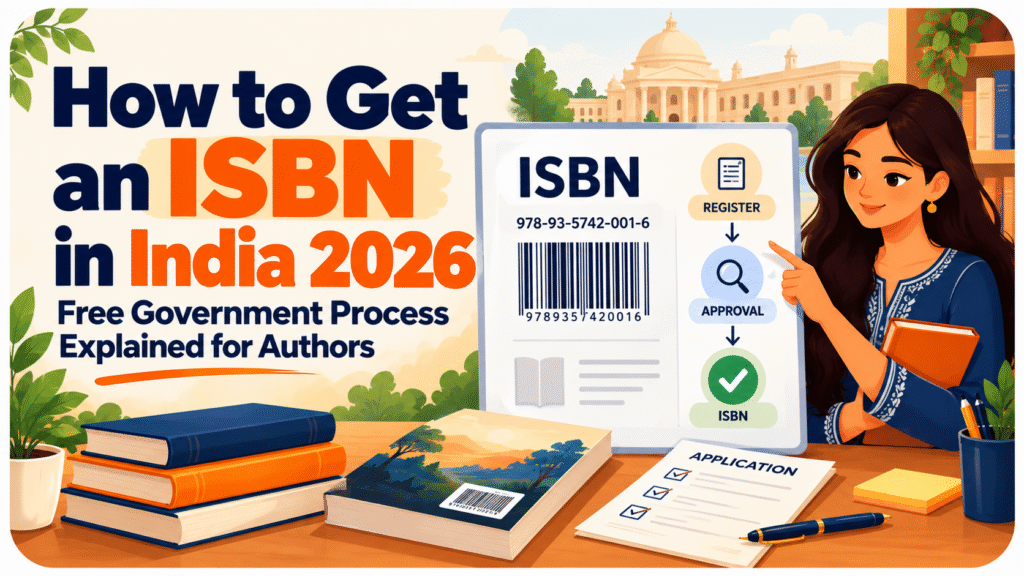
ISBN India is managed through the Raja Rammohun Roy National Agency for ISBN under the Government of India. Authors, self-publishers and publishing organisations in India can apply through the official ISBN portal.
For Indian applicants, the national agency handles ISBN requests. In addition, individual self-publishers can apply directly instead of depending on a printer or publishing platform.
Therefore, authors who plan to publish independently should understand the process before finalising their book details. This guide explains the 2026 ISBN application process in simple language.
What Is an ISBN?
ISBN stands for International Standard Book Number. It is a unique 13-digit number used to identify a specific book edition or format.
For example, booksellers, libraries and distributors use ISBNs to identify books correctly. As a result, the number makes ordering and cataloguing easier.
However, an ISBN does not prove copyright ownership. Its main purpose is book identification.
Is an ISBN Required in India?
An ISBN is not the same as copyright registration, and the ISBN system itself does not create a legal publishing requirement.
Still, most authors who want wider distribution benefit from having one. For instance, bookstores, libraries and many online systems use ISBNs for identification.
Therefore, authors planning commercial distribution should usually consider applying for an ISBN.
Who Issues ISBNs in India?
The Raja Rammohun Roy National Agency for ISBN issues ISBNs for books published from India.
More importantly, the publisher’s location decides which ISBN agency should handle the request. The book’s language or printing location does not normally change that.
For this reason, Indian publishers and self-publishers should apply through the Indian national agency.
ISBN India: Is the Government ISBN Free?
The Indian ISBN system is handled through the government agency. Authors and publishers should apply through the official portal rather than buying an ISBN from an unrelated third party.
In particular, self-publishers should avoid using ISBNs that belong to a printer or service provider. Instead, they should apply in their own name when they want to remain the publisher of record.
As a result, the book’s publisher details stay clearer and more accurate.
Who Can Apply for an ISBN in India?
Large publishing companies are not the only eligible applicants. Individual authors can also apply when they publish their own books.
In addition, institutions and organisations that bring books into publication may also qualify under the appropriate category.
Applicants may include:
- Individual authors
- Self-publishers
- Publishing companies
- Educational institutions
- Organisations that publish books
How to Apply for an ISBN in India
The application begins with registration on the official ISBN portal.
First, choose the correct applicant type. Next, select the relevant publisher category and review the required documents.
After that, enter your details carefully and submit the registration form. Once the system approves registration, you can continue with the ISBN request.
Open the official ISBN portal.
Select Applicant Registration.
Choose the correct applicant and publisher category.
Check the required documents.
Enter your details and active email address.
Submit the form.
Use the login details sent to your email.
Complete the ISBN request with accurate book information.
What Documents Do You Need?
The document list can differ by applicant category. Therefore, authors should not depend on one fixed list copied from an old article.
Instead, choose the correct applicant and publisher type on the portal first. The system then shows the documents required for that category.
This approach helps reduce errors and prevents applicants from uploading unnecessary or incorrect files.
How the ISBN Approval Process Works
The process normally moves through more than one stage. Therefore, registration does not mean the ISBN is issued immediately.
| Stage | What Happens |
|---|---|
| Registration Review | The agency checks applicant details and documents |
| Category Review | The agency checks the selected publisher category |
| ISBN Allotment | The agency assigns the ISBN after reviewing the book details |
As a result, accurate information at each stage can help avoid unnecessary delays.
How Long Does ISBN Approval Take?
The official FAQ gives a normal timeline of around 7 to 9 working days from registration.
However, actual processing time can vary. For example, incomplete information or a high number of applications may slow the process.
Therefore, apply well before the planned printing or publication date.
Do Different Book Formats Need Different ISBNs?
An ISBN identifies a specific publication and format.
For example, a paperback and a hardcover are different product forms. Therefore, authors should check the current ISBN rules before assigning one number to several formats.
Likewise, a new edition with major changes may need separate treatment.
Can a Self-Published Author Apply Directly?
Yes. Independent authors can apply directly when they publish their own books.
This can be useful because the author does not need to depend on another company simply to obtain the identifier.
As a result, the publishing details can remain connected with the correct self-publisher.
Should You Use an ISBN From a Printer?
A printer may help an author with the process, but printing a book does not automatically make the printer its publisher.
Therefore, the ISBN should match the genuine publisher or self-publisher responsible for the book.
If you plan to publish under your own name or imprint, apply under the correct details from the beginning.
What About ISBNs From Self-Publishing Platforms?
Some platforms provide an ISBN from their own range. In that situation, the platform may appear as the publisher connected with that ISBN.
However, authors who want more control may prefer to obtain their own ISBN.
This can make future distribution under the author’s own publishing identity easier.
Does an ISBN Protect Copyright?
No. ISBN and copyright serve different purposes.
An ISBN identifies the publication. Copyright, on the other hand, relates to ownership and rights in the work.
Therefore, authors should not treat an ISBN as copyright registration.
Does Book Language Affect ISBN Registration?
The publisher’s location matters more than the language of the book when choosing an ISBN agency.
For example, an Indian publisher can publish an English, Hindi or another-language book and still apply through the Indian ISBN agency.
Therefore, language alone does not normally require a foreign ISBN agency.
Common ISBN Application Mistakes
Small application errors can slow down the process. Fortunately, most are easy to avoid.
- Choosing the wrong applicant category
- Uploading incomplete documents
- Using an inactive email address
- Entering inconsistent publisher information
- Submitting incorrect book details
- Using another publisher’s ISBN
- Waiting until printing is about to begin
Above all, check every detail before submitting the application.
ISBN India Application Checklist
- Correct applicant category selected
- Correct publisher type selected
- Required documents ready
- Active email address entered
- Publisher details checked
- Book title finalised
- Author name confirmed
- Format details checked
- Book metadata prepared
- Application status monitored
Official ISBN Resources
Because portal rules can change, always use current government information.
The
Raja Rammohun Roy National Agency for ISBN
is the official Indian ISBN portal.
In addition, the
Ministry of Education ISBN page
provides official information about the programme.
More Publishing Guides for Authors
If you plan to publish through Amazon, read our
Amazon KDP India 2026 guide
You can also review our
Book cover design guide
before preparing the final publication files.
Frequently Asked Questions About ISBN India
Can an Individual Author Apply for an ISBN in India?
Yes. Individual authors can apply as self-publishers when they are responsible for publishing their own books.
How Long Does the ISBN Process Take?
The official FAQ gives a normal timeline of around 7 to 9 working days. However, actual processing time can vary.
Can I Use an ISBN Given by My Printer?
The ISBN should normally match the genuine publisher. Therefore, authors publishing independently should apply under the correct self-publisher details.
Does an ISBN Protect My Copyright?
No. An ISBN identifies a publication but does not provide copyright protection.
Can I Apply for an Indian ISBN for an English Book?
Yes. An Indian publisher can apply through the Indian ISBN agency regardless of whether the book is written in English, Hindi or another language.
How Tarang Prakashan Looks at ISBN Registration
At Tarang Prakashan, ISBN registration is treated as an important part of preparing book information correctly.
For that reason, the ISBN should match the real publisher, edition and format of the book.
Accurate information at the beginning can also make future distribution and identification easier.
ISBN India: Final Thoughts
ISBN India applications go through the Raja Rammohun Roy National Agency for ISBN.
First, select the correct applicant category. Next, prepare the required documents and enter accurate publisher details.
Then complete the remaining ISBN request stages carefully. As a result, the book can be linked with the correct publication information.
Most importantly, use the official government portal and current instructions instead of depending on transferred ISBNs or outdated advice.