




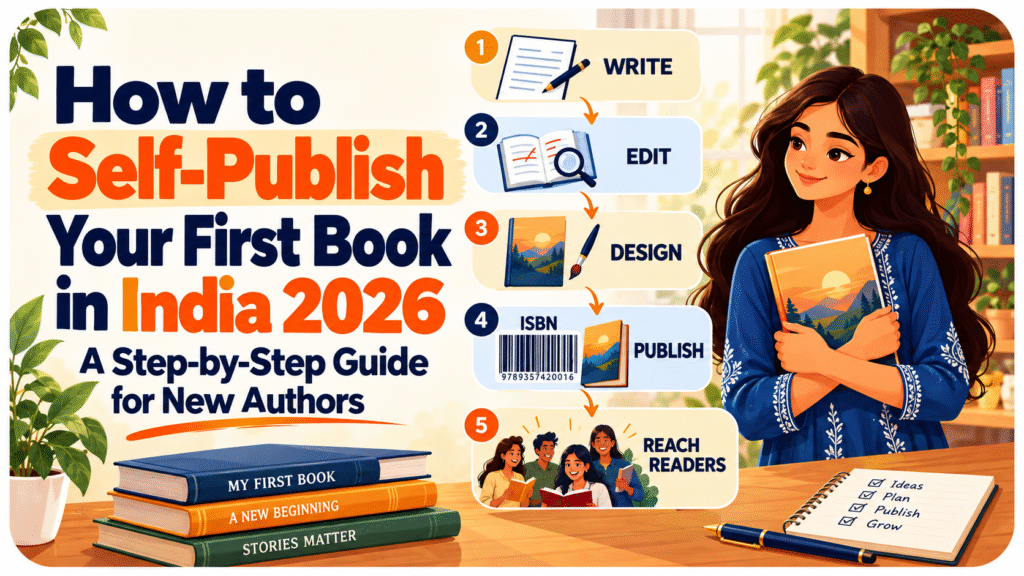
Self publishing India has become a practical option for writers who want more control over their book, timeline and publishing decisions. However, publishing your first book involves much more than simply uploading a manuscript online.
New authors need to think about editing, proofreading, book design, ISBN, pricing, printing, eBook preparation, distribution and marketing. Therefore, following the steps in the right order can save both time and money.
This 2026 guide explains how to self-publish your first book in India in simple language. It covers the complete journey from manuscript preparation to making the finished book available to readers.
What Does Self-Publishing Mean?
Self-publishing means the author takes responsibility for bringing the book to market instead of depending entirely on a traditional publisher.
That does not mean the author must personally do every task. For example, editors, designers, printers and publishing-service providers can still help with professional work.
However, the author usually has greater control over decisions such as the cover, price, publishing timeline and where the book is made available.
Self Publishing India: Understand the Full Process First
Before spending money on printing or promotion, understand the complete publishing workflow.
Following this order helps prevent common problems. For instance, designing a final print cover before confirming the interior page count can create an incorrect spine width.
1. Finish the Manuscript Before Publishing
Your first goal should be a complete manuscript rather than an unfinished draft.
Before moving to design or ISBN registration, read the book from beginning to end. Then fix missing chapters, repeated ideas and obvious inconsistencies.
Before moving ahead, check:
- All chapters are complete
- Chapter order is final
- Title is close to final
- Author name is decided
- Duplicate text has been removed
- Basic spelling errors have been checked
As a result, professional editing becomes easier and more focused.
2. Edit and Proofread Your Book
Editing is one of the most important stages in self-publishing.
A book may have a strong idea but still feel difficult to read because of weak structure, repeated points or language errors. Therefore, do not treat editing as optional.
Editing and proofreading also serve different purposes. Editing improves structure, clarity and language, while proofreading checks smaller errors near the end of the process.
For a detailed breakdown, read our
Book editing guide for self-published Indian authors
3. Decide Your Book Format
Next, decide which formats you want to publish.
Many authors choose a paperback first because it is familiar and often less expensive to produce than a hardcover. Meanwhile, an eBook can give readers a digital option.
| Format | Useful For | Key Consideration |
|---|---|---|
| Paperback | General readers | Printing cost and MRP |
| Hardcover | Premium editions | Higher production cost |
| eBook | Digital readers | Reflowable digital formatting |
You do not need to launch every format on the same day. Instead, choose the formats that make sense for your readers and budget.
4. Choose the Right Book Size
The physical size of the book affects both appearance and printing cost.
Novels often use smaller trim sizes, while workbooks, academic titles and illustrated books may need larger pages.
Therefore, choose the trim size before final typesetting. Changing it later can alter page count, margins and spine width.
5. Typeset the Interior Professionally
Typesetting turns an edited manuscript into actual book pages.
This stage controls details such as font size, margins, chapter openings, page numbers, paragraph spacing and headers.
For print publishing through Amazon KDP, authors upload an interior manuscript and a separate cover file. KDP also requires authors to set trim size and suitable margins before upload.
Therefore, review the final PDF page by page before approving it for print.
6. Design a Professional Book Cover
Readers often see the cover before they read the description. For that reason, design should communicate the genre quickly.
A professional cover also needs to work at thumbnail size. In addition, print editions need a correctly prepared front, spine and back cover.
Do not finalise the spine until the interior page count and paper specifications are confirmed.
For more detail, see our
Book cover design guide for Indian authors
7. Get an ISBN in India
ISBN stands for International Standard Book Number. It helps identify a specific publication or edition.
In India, ISBN applications go through the Raja Rammohun Roy National Agency for ISBN.
Self-published authors can apply under the appropriate category. Therefore, you do not necessarily need a traditional publishing company simply to apply for an ISBN.
Use the
Official Indian ISBN portal
for current application information.
You can also read our
ISBN India 2026 guide
for a step-by-step explanation.
8. Understand Copyright and ISBN Separately
ISBN and copyright are not the same thing.
An ISBN identifies a publication. Copyright deals with rights in the creative work.
If you choose to file a copyright registration application in India, the Copyright Office currently provides an online filing process for literary works.
Therefore, do not assume that obtaining an ISBN automatically registers your copyright.
9. Decide How You Will Print the Book
Authors generally have two broad approaches: print copies in advance or use print-on-demand where available.
Printing copies in advance can lower the cost per copy at larger quantities. However, it also creates inventory and storage needs.
Print-on-demand reduces the need to hold stock because copies are produced as orders arrive. On the other hand, the per-copy cost may be higher.
Therefore, choose the printing model based on expected sales, budget and distribution plan.
10. Set the Right Book Price
Book pricing should start with actual production cost.
After that, consider retailer discounts, marketplace deductions, distribution costs and the amount that should remain after each sale.
Do not set the MRP only by looking at printing cost. Instead, compare similar books and think about what your target reader expects to pay.
Our
Book pricing India 2026 guide
explains this calculation in more detail.
11. Prepare an eBook Version
An eBook should not simply be treated as the print PDF displayed on a smaller screen.
For most text-heavy books, reflowable eBook formatting works better because readers can change the font size and screen orientation.
Amazon KDP currently accepts several eBook manuscript formats, including DOC/DOCX, KPF and EPUB. It recommends previewing the converted book before publishing.
Therefore, check headings, paragraph breaks, images and the table of contents on digital devices before launch.
12. Understand Amazon KDP Before Using It
Amazon KDP is one option for authors who want to publish Kindle eBooks and supported print editions.
However, authors should understand format and language limitations before preparing files.
For example, KDP currently supports Kindle eBooks in Hindi, Tamil, Malayalam, Marathi and Gujarati, while its Indian-language guidance says paperback publishing for those languages is not currently available.
You can read our
Amazon KDP India 2026 guide
before creating your title.
13. Decide Where Readers Can Buy the Book
Publishing and distribution are different tasks.
A finished book still needs sales channels through which readers can find and order it.
Depending on your publishing plan, channels may include:
- Online bookstores
- Your own website
- Direct author sales
- Bookstores
- Book fairs
- Institutional sales
- Digital eBook stores
Therefore, decide the distribution plan before printing a large number of copies.
14. Build Your Author Platform
Your book should not be the only way readers can find you.
A simple author platform can include a website, newsletter and one main social media channel.
Moreover, starting before publication gives you time to build reader interest gradually rather than beginning from zero on launch day.
You can explore our
Author platform India guide
for a longer-term approach.
15. Market the Book Before and After Launch
Book marketing should begin before launch, but it should not end there.
For example, authors can use reader reviews, social content, email, interviews, book clubs, events and selected advertising.
However, promotion works better when the cover, book description, price and product page are already strong.
For a practical plan, read our
Book marketing India 2026 guide
How Much Does Self-Publishing Cost in India?
There is no single fixed self-publishing cost because every book needs different services.
A simple text-based book may cost less to prepare than an illustrated children’s title or a heavily designed workbook.
Costs may include:
- Editing
- Proofreading
- Typesetting
- Cover design
- Printing
- eBook preparation
- Distribution support
- Marketing
Therefore, compare services rather than judging a publishing option only by the total package price.
DIY Self-Publishing vs Publishing Support
| Option | Main Advantage | Main Challenge |
|---|---|---|
| DIY Self-Publishing | Greater direct control | Author manages many technical tasks |
| Professional Publishing Support | Specialists handle selected stages | Author must compare quality and services carefully |
Neither route is automatically better for every author. Instead, choose based on your skills, available time and the level of professional support the book needs.
Common First-Time Self-Publishing Mistakes
- Publishing an unedited manuscript
- Choosing a cover only because it looks attractive
- Ignoring thumbnail readability
- Setting the MRP without calculating costs
- Using incorrect ISBN details
- Printing too many copies without a sales plan
- Uploading files without previewing them
- Starting marketing only after publication
- Trying to use every social media platform
- Expecting sales simply because the book is online
Fortunately, a clear publishing checklist can prevent most of these problems.
First Book Self-Publishing Checklist
- Manuscript completed
- Editing completed
- Proofreading completed
- Trim size selected
- Interior typeset
- Cover designed
- ISBN arranged where required
- Book price calculated
- Print file checked
- eBook file checked
- Distribution channels selected
- Author profile prepared
- Marketing plan prepared
- Final proof reviewed before launch
Frequently Asked Questions About Self-Publishing in India
Can a First-Time Author Self-Publish in India?
Yes. A first-time author can self-publish by managing the required editing, design, ISBN, printing, digital publishing and distribution steps directly or with professional support.
Do I Need an ISBN to Self-Publish?
The answer depends on the format and platform. For example, Kindle eBooks published through KDP do not require an ISBN, while print publishing may use an ISBN depending on the publishing route.
Can I Publish My Book on Amazon Myself?
Yes. Amazon KDP allows authors to create an account and upload supported eBook and print titles directly.
Can I Self-Publish a Hindi Book?
Yes, although platform support can vary by format. For example, KDP currently supports Hindi Kindle eBooks but lists Hindi as eBook-only in its supported-language guidance.
Should I Print Books Before I Have Orders?
Not always. The right approach depends on expected demand, storage space, budget and whether print-on-demand is available for your sales channel.
How Long Does Self-Publishing Take?
The timeline depends on manuscript condition, editing, design, ISBN work, proofing and platform review. Therefore, a professionally prepared book should not be rushed simply to meet an arbitrary date.
How Tarang Prakashan Looks at Self-Publishing
At Tarang Prakashan, self-publishing is treated as a complete book-production process rather than simply uploading a manuscript.
Editing, cover design, typesetting, book details, pricing and distribution all affect the final reader experience. Therefore, each stage should be completed in the correct order.
At the same time, authors should understand the decisions being made about their own books rather than treating publishing as a completely hidden process.
Self Publishing India: Final Thoughts
Self publishing India becomes much easier when authors treat it as a sequence of clear steps.
First, finish and edit the manuscript. Next, prepare the interior and cover, arrange the correct book details and decide how the book will be priced and distributed.
After that, check every final file carefully before publishing. Finally, continue marketing after launch rather than expecting the listing alone to create sales.
Your first book does not need to be rushed. A careful publishing process gives the writing a better chance to reach readers in the professional form it deserves.