




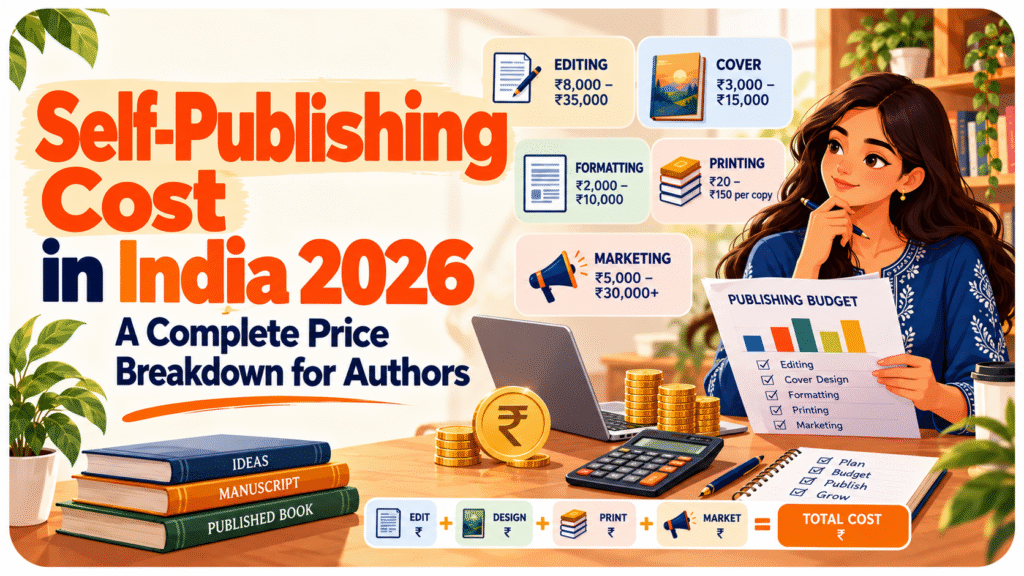
Self publishing cost India can range from a small DIY budget to a much larger professional investment. The final amount depends on the manuscript, editing level, cover design, formatting, printing, distribution and marketing choices.
Therefore, there is no single correct price for publishing every book. A short poetry collection may need a very different budget from a 400-page novel, children’s book or illustrated workbook.
This 2026 guide breaks the main costs into simple parts. It also explains where authors can save money, where professional work matters most and which expenses are optional.
How Much Does Self-Publishing Cost in India?
For many professionally prepared books, the total budget can fall roughly between ₹15,000 and ₹80,000 or more. However, this is only a broad market range.
A basic project can cost less when the author handles editing, formatting or marketing personally. On the other hand, developmental editing, custom illustration, large print runs or extensive promotion can push the budget much higher.
As a result, authors should compare individual services rather than judging a publishing offer only by the final package price.
| Publishing Level | Indicative Budget | Usually Includes |
|---|---|---|
| DIY / Basic | ₹5,000 – ₹15,000 | Basic cover, formatting, digital setup, limited professional support |
| Professional | ₹20,000 – ₹60,000 | Editing, custom cover, formatting, publishing setup and basic distribution |
| Premium | ₹70,000 – ₹1,50,000+ | Deeper editing, illustration, larger print requirements, PR or extensive marketing |
These ranges are only planning estimates. Your actual cost will depend on the book and the professionals or publishing services you choose.
1. Editing and Proofreading Cost
Editing can take a large part of the publishing budget, especially for longer manuscripts.
However, not every manuscript needs the same level of work. A clean manuscript may only need copy editing and proofreading, while another book may first need structural changes.
| Editing Type | Indicative Cost | Main Purpose |
|---|---|---|
| Proofreading | ₹3,000 – ₹15,000+ | Typos, spelling, punctuation and final errors |
| Copy / Line Editing | ₹8,000 – ₹35,000+ | Clarity, grammar, consistency and sentence flow |
| Developmental Editing | ₹20,000 – ₹60,000+ | Structure, chapter flow, plot or argument |
In addition, word count has a major effect on editing cost. Therefore, compare quotes using the same manuscript length and editing level.
Our
Book editing guide for Indian authors
explains these stages in more detail.
2. Book Cover Design Cost
Cover design can be very inexpensive or highly customised.
For example, a template-based design may cost only a few thousand rupees. Meanwhile, an experienced cover specialist or illustrator may charge much more for original work.
Typical options include:
- Template-based cover: around ₹500 – ₹3,000
- Custom freelance cover: around ₹3,000 – ₹10,000+
- Professional custom cover: around ₹10,000 – ₹35,000+
- Illustrated cover: can rise further depending on artwork
Instead of choosing only by price, review the designer’s previous book covers and genre experience.
Our
Book cover design guide
covers the main design and print requirements.
3. Typesetting and Interior Formatting Cost
Typesetting turns the edited manuscript into professional book pages.
For a normal text-based book, professional formatting may cost roughly ₹2,000 to ₹10,000. However, workbooks, poetry, tables, academic content and illustrated books may require more work.
In addition, eBook formatting may be charged separately from print formatting.
Formatting cost can depend on:
- Page count
- Tables and charts
- Images
- Footnotes
- Poetry or unusual layouts
- Print and eBook versions
4. ISBN Cost in India
Indian authors can apply for an ISBN through the Raja Rammohun Roy National Agency for ISBN.
The government ISBN itself is available without an ISBN purchase fee. Therefore, authors should not automatically assume that they need to buy an ISBN from a private provider.
However, a publishing company may charge for administrative support if it handles the ISBN process as part of a wider service package.
For the official process, visit the
Indian ISBN portal
You can also read our
ISBN India 2026 guide
5. Printing Cost
Printing is one of the most variable self-publishing expenses.
Page count, book size, paper, colour pages, binding and quantity all affect the cost per copy. As a result, quoting one fixed printing price for every book would be misleading.
Printing cost usually depends on:
- Trim size
- Number of pages
- Black-and-white or colour interior
- Paper quality
- Paperback or hardcover binding
- Number of copies
For example, a short black-and-white paperback may be relatively inexpensive per copy, while a large colour workbook or hardcover can cost several times more.
6. Print-on-Demand vs Bulk Printing Cost
Print-on-demand and bulk printing solve different problems.
With print-on-demand, copies are produced when orders arrive. Therefore, authors do not need to invest in a large quantity of stock at the beginning.
Bulk printing often reduces the per-copy price. However, the author must pay for more copies in advance and manage storage.
| Printing Model | Main Advantage | Main Cost Concern |
|---|---|---|
| Print-on-Demand | Low inventory risk | Higher per-copy cost in many cases |
| Bulk Printing | Lower cost per copy at volume | Higher upfront payment and storage needs |
7. Amazon KDP Publishing Cost
Amazon KDP does not charge an upfront fee simply to create and upload an eligible book.
However, that does not mean producing a professional book costs nothing. Editing, design and formatting still need to be handled separately.
For print books, KDP calculates printing cost based mainly on factors such as marketplace, page count and ink type. Amazon then uses that cost when calculating the minimum list price and royalty.
You can read our
Amazon KDP India 2026 guide
for more detail.
8. eBook Formatting Cost
A simple text-based eBook can be inexpensive to prepare, while illustrated or highly formatted books may cost more.
In the Indian market, basic professional eBook formatting may commonly fall around ₹1,500 to ₹5,000 or more, depending on complexity.
Therefore, ask whether EPUB or other required digital files are already included in the publishing package before paying separately.
9. Distribution Cost
Distribution costs are often misunderstood because authors may expect one payment to place the book everywhere permanently.
In reality, online listings, physical distribution, warehousing and bookstore placement can use different commercial models.
For example, a retailer may work through discounts or commissions rather than charging a simple one-time listing fee.
Therefore, check exactly what the word “distribution” means in any publishing package.
10. Book Marketing Cost
Marketing can cost almost nothing or become the largest part of the publishing budget.
Organic social content, reviewer outreach and author networking can begin with a small budget. In contrast, paid advertising, PR, influencer campaigns and launch events may require much more.
| Marketing Level | Possible Budget | Examples |
|---|---|---|
| Low-Cost | ₹0 – ₹5,000 | Organic social media, direct outreach, reader groups |
| Planned Campaign | ₹5,000 – ₹30,000+ | Ads, review copies, creatives, selected promotions |
| Premium Campaign | ₹30,000 – ₹1,00,000+ | PR, events, larger ad campaigns or creator outreach |
However, spending more does not guarantee sales. A strong campaign still needs the right audience, book presentation and pricing.
Read our
Book marketing India 2026 guide
before setting a marketing budget.
11. Author Copies and Shipping
Author copies are another cost that first-time writers sometimes forget.
If you order copies for personal use, events, reviewers or direct sales, calculate both printing and delivery charges.
In addition, sending review copies to several cities can create a noticeable courier expense. Therefore, add shipping to the launch budget rather than treating it as an afterthought.
12. Optional Copyright Registration Cost
ISBN and copyright are different.
An ISBN identifies a publication, while copyright deals with rights in the work. Therefore, authors should not pay for “ISBN copyright” as if it were one combined registration.
If you decide to use formal copyright registration, check the latest government fee and application requirements directly through the Indian Copyright Office before budgeting for it.
A Sample Self-Publishing Budget
Consider a straightforward text-based paperback where the manuscript already needs only moderate professional work.
| Service | Illustrative Budget |
|---|---|
| Editing and proofreading | ₹10,000 |
| Cover design | ₹5,000 |
| Typesetting | ₹3,500 |
| eBook formatting | ₹2,000 |
| ISBN application fee | ₹0 through government agency |
| Initial author copies / printing | ₹5,000 |
| Basic promotion | ₹5,000 |
| Illustrative Total | ₹30,500 |
This is only an example, not a standard publishing price. A different manuscript could cost far less or considerably more.
Where Can Authors Save Money?
Saving money does not always mean choosing the cheapest provider.
Instead, authors can reduce unnecessary costs by preparing the manuscript properly and paying professionals only for work they actually need.
You may save money by:
- Self-editing before professional editing
- Finalising the manuscript before typesetting
- Avoiding repeated cover redesigns
- Using the free government ISBN process
- Starting with a smaller print quantity
- Testing marketing before increasing ad spend
- Comparing clearly defined service scopes
Where Should You Avoid Cutting Costs?
Some shortcuts may save money initially but reduce the final quality of the book.
For example, skipping editing can leave visible language problems. Likewise, a weak cover can make an otherwise strong book look unprofessional.
Be careful about cutting too much from:
- Editing
- Final proofreading
- Cover quality
- Print-ready file preparation
- Proof-copy checking
A reader notices the finished book, not how cheaply it was produced.
Hidden Costs Authors Should Ask About
A low package price can become expensive if several useful services are charged separately later.
Before paying, ask whether the quotation includes:
- GST
- Revision rounds
- Paperback formatting
- eBook formatting
- Cover revisions
- Author copies
- Courier charges
- Distribution duration
- Future file corrections
- Marketing deliverables
Therefore, compare the complete scope of work rather than only the number written at the bottom of the quotation.
Self Publishing Cost India Checklist
- Manuscript word count confirmed
- Editing level decided
- Cover type decided
- Print format selected
- Typesetting cost checked
- eBook formatting checked
- ISBN process understood
- Printing quotation obtained
- Author-copy cost calculated
- Shipping considered
- Distribution terms understood
- Marketing budget decided
- GST and other charges checked
More Guides for Self-Published Authors
If this is your first book, start with our
Step-by-step self-publishing India guide
You can also review our
Book pricing India 2026 guide
before setting the final MRP.
For Amazon publishing, see the
Amazon KDP India 2026 guide
Frequently Asked Questions About Self-Publishing Cost
How Much Does It Cost to Self-Publish a Book in India?
A professional self-publishing project may commonly fall somewhere around ₹15,000 to ₹80,000 or more. However, the actual amount depends on the services and book requirements.
Can I Self-Publish a Book for Free?
Some publishing platforms do not charge an upfront upload fee. However, professional editing, cover design, formatting, printing and marketing may still create costs.
Is ISBN Free in India?
Indian applicants can use the government ISBN system without purchasing the ISBN itself from a commercial agency.
What Is the Most Expensive Part of Self-Publishing?
The answer depends on the book. For a long manuscript, editing may become the largest cost. For an illustrated children’s book, artwork and colour printing may cost more.
Do I Need to Print Hundreds of Copies?
No. Authors can begin with smaller quantities or use print-on-demand where suitable. Bulk printing becomes useful when expected demand justifies the inventory.
Should I Choose the Cheapest Publishing Package?
Not automatically. First compare the services, quality, ownership terms, distribution, royalty structure and hidden charges. Then judge whether the total offer fits your book.
How Tarang Prakashan Looks at Publishing Cost
At Tarang Prakashan, publishing cost should be understood service by service rather than as a single unexplained number.
Different manuscripts need different levels of editing, design and production. Therefore, the same budget cannot suit every author or every book.
The aim should be to spend where the book genuinely needs professional support while avoiding unnecessary additions.
Self Publishing Cost India: Final Thoughts
Self publishing cost India depends far more on the book’s actual needs than on one fixed package price.
First, understand the condition of your manuscript. Next, decide which editing, design, formatting and printing services are genuinely required.
After that, add distribution, author copies and marketing to the budget. Finally, compare quotations using the same scope of work.
A sensible publishing budget is not necessarily the cheapest one. It is the budget that gives the book the professional work it needs without paying for services that add little value.