




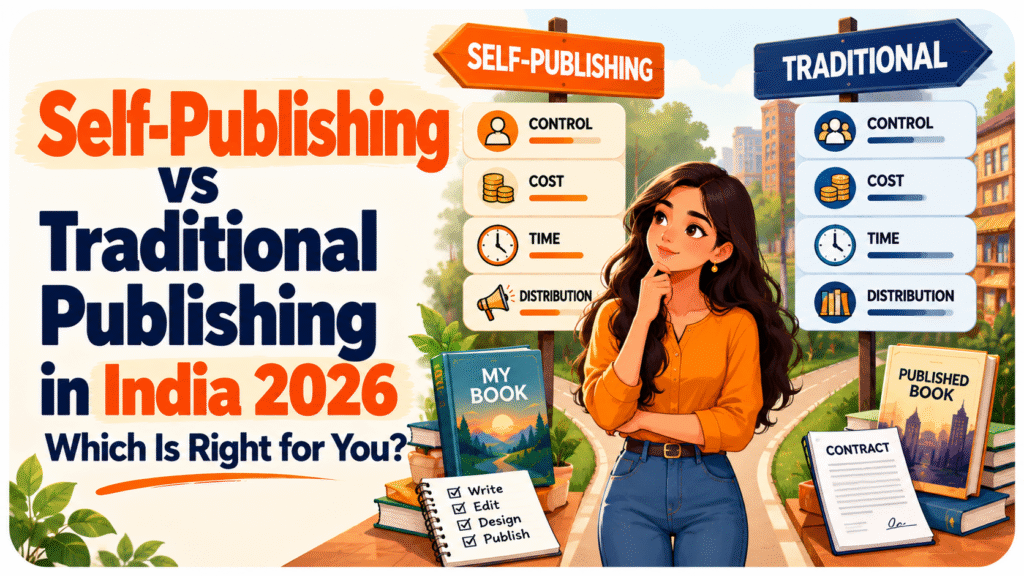
Choosing between different publishing options India offers can be confusing for a new author. Self-publishing gives writers more control over the process, while traditional publishing usually places more responsibility with the publisher.
However, neither model is automatically better for every writer. The right choice depends on your manuscript, budget, goals, patience, need for control and expectations from the publisher.
Therefore, this 2026 guide compares self-publishing and traditional publishing in simple terms. It explains cost, timeline, royalties, distribution, creative control and the type of author each model may suit.
What Is Self-Publishing?
Self-publishing means the author takes the lead in bringing the book to market.
The writer may hire editors, designers, printers or publishing-service companies. However, the author usually keeps greater control over decisions such as the cover, price, publishing date and formats.
In addition, the author normally pays for the professional services required to prepare and release the book.
What Is Traditional Publishing?
Traditional publishing usually begins when a publisher chooses to acquire a manuscript for publication.
In this model, the publisher generally manages professional stages such as editing, design, production and distribution according to its own publishing process.
As a result, the author may not need to pay for standard publishing production. However, the publisher usually has greater control over decisions such as the release schedule, cover and commercial strategy.
Self-Publishing vs Traditional Publishing at a Glance
| Factor | Self-Publishing | Traditional Publishing |
|---|---|---|
| Upfront Cost | Usually paid by author | Usually handled by publisher |
| Creative Control | Higher | Shared or publisher-led |
| Publishing Speed | Can be faster | Often longer |
| Selection Process | Author decides to publish | Publisher selects manuscripts |
| Royalty Structure | Depends on sales channel and service model | Defined in publishing contract |
| Publishing Risk | More financial risk with author | More investment risk with publisher |
1. Cost: Who Pays for Publishing?
Cost is one of the biggest differences between the two models.
With self-publishing, the author normally pays for services such as editing, cover design, typesetting, printing and marketing.
Traditional publishers, on the other hand, usually invest in the books they choose to publish. Therefore, the author should not normally need to pay the standard production cost in a genuine traditional publishing arrangement.
If cost is a major concern, read our
Self-publishing cost India 2026 guide
2. Creative Control
Self-publishing usually gives authors more direct control.
For example, the author may choose the cover direction, interior style, title, pricing and publication date.
In traditional publishing, these decisions may involve editors, designers, sales teams and the publisher. As a result, the final decision may not always remain with the author.
Therefore, writers who strongly value control may prefer the self-publishing model.
3. Publishing Timeline
Self-publishing can move quickly when the manuscript and production files are ready.
However, authors should not confuse speed with quality. Editing, proofreading and design still need enough time.
Traditional publishing can take longer because the process may involve manuscript review, contract discussions, editorial schedules, production planning and a future release calendar.
Therefore, authors with a fixed personal deadline may find self-publishing easier to schedule.
4. Manuscript Selection
Traditional publishing involves selection.
A publisher may reject a manuscript even when the writing is good because it does not fit the current list, market direction or publishing programme.
Self-publishing removes that gatekeeping step. Instead, the author decides whether the manuscript is ready to publish.
However, that freedom also places more responsibility on the author to maintain quality.
5. Editing and Quality Control
Both publishing models need good editing.
In traditional publishing, the publisher usually manages the editorial process. Meanwhile, self-published authors need to arrange editing themselves or hire professional support.
Therefore, self-publishing should never mean skipping professional review.
Our
Book editing guide
explains developmental editing, copy editing and proofreading.
6. Book Cover and Design Decisions
A self-published author usually has greater influence over the cover.
Traditional publishers, however, may design the book according to their list, market research and sales strategy.
Authors may still give feedback, but the final cover may not match their first idea.
If you are preparing your own edition, review our
Book cover design guide
7. ISBN and Publisher Identity
In a traditional publishing arrangement, the publisher normally handles the book’s publication details and ISBN.
Self-published authors may instead apply under their own self-publisher details where appropriate.
In India, authors can use the official
Raja Rammohun Roy National Agency for ISBN
for current ISBN information.
For a complete explanation, see our
ISBN India 2026 guide
8. Royalties and Earnings
Royalty structures differ widely between publishing models.
A traditional publishing contract may calculate royalty using a percentage or another agreed method. Therefore, authors should read the contract carefully instead of assuming one standard rate applies everywhere.
Self-published authors may keep a larger share of the net amount from a sale. However, they also carry more of the production and marketing cost.
For that reason, a higher royalty percentage does not automatically mean greater profit.
9. Book Pricing
Self-published authors usually have more control over pricing.
However, price should still consider printing cost, platform deductions, retailer discounts and reader expectations.
Traditional publishers normally set the price using their own production and sales model.
Our
Book pricing India guide
explains how authors can think about MRP and costs.
10. Distribution
Distribution is another major difference.
Traditional publishers may already have established relationships with distributors, online retailers and booksellers.
Self-published authors need to arrange suitable sales channels themselves or work with a service provider.
As a result, authors should understand the difference between simply listing a book online and building wider distribution.
11. Marketing Responsibility
Authors sometimes assume that traditional publishing means the publisher will handle every part of marketing.
In practice, author participation can still matter. Social media, events, interviews and reader communication may form part of the launch effort.
Self-published authors generally carry even more responsibility for creating awareness.
Therefore, writers choosing self-publishing should plan marketing before launch rather than after publication.
Our
Book marketing India guide
covers practical strategies.
12. Rights and Contracts
Publishing rights deserve careful attention in both models.
With self-publishing, authors often retain broad control because they arrange the publishing services directly.
Traditional publishing usually involves a contract that grants specific publishing rights to the publisher for an agreed period, territory or format.
Therefore, always read the agreement carefully and understand which rights are being licensed or assigned before signing.
Which Publishing Model May Suit You?
| Your Priority | Model to Explore |
|---|---|
| You want greater creative control | Self-Publishing |
| You do not want to fund production yourself | Traditional Publishing |
| You want to choose your own publication date | Self-Publishing |
| You prefer a publisher-led production process | Traditional Publishing |
| You are comfortable managing professionals and services | Self-Publishing |
This table is a starting point rather than a rule. Authors should consider the complete situation before choosing a route.
Questions to Ask Before Choosing
Do I have a publishing budget?
How much creative control do I want?
Am I willing to wait for publisher selection?
Do I want to manage editing, design and production?
How quickly do I want the book released?
How important is bookstore distribution to me?
Am I prepared to take an active role in marketing?
What Is Hybrid or Assisted Self-Publishing?
Some authors choose a middle path.
In assisted self-publishing, the author funds professional services while a publishing team handles selected stages such as editing, design, printing or distribution.
However, service models vary widely. Therefore, authors should check ownership, royalty, distribution, revision and contract terms carefully before paying.
The important point is to understand exactly what the company is offering rather than judging it only by the label used.
Common Mistakes When Choosing a Publishing Route
- Choosing only by the lowest package price
- Assuming every publisher offers the same services
- Ignoring publishing rights
- Not reading the royalty clause
- Expecting guaranteed sales
- Printing too many copies without demand
- Paying a company that calls itself traditional while charging unclear publishing fees
- Signing a contract without checking duration and termination terms
Above all, understand the business model before agreeing to publish.
More Publishing Guides for Indian Authors
If you are planning your first independent book, read our
Self-publishing India step-by-step guide
You can also review our
Self-publishing cost breakdown
before setting your budget.
For authors considering Amazon, our
Amazon KDP India guide
covers publishing formats, ISBNs and basic platform information.
Frequently Asked Questions
Is Self-Publishing Better Than Traditional Publishing?
Neither model is better for every author. Self-publishing offers more control, while traditional publishing usually shifts more production responsibility to the publisher.
Do Traditional Publishers Charge Authors?
In a standard traditional publishing model, the publisher normally funds the production of books it chooses to publish. Authors should examine any paid offer carefully to understand the actual publishing model.
Do Self-Published Authors Keep Their Copyright?
Copyright and publishing rights should be checked in the specific agreement. Self-published authors often retain broad rights, but any service or distribution contract should still be read carefully.
Which Route Is Faster?
Self-publishing can usually move faster because the author controls the schedule. However, professional editing and production should still receive enough time.
Can a Self-Published Book Later Get a Traditional Publisher?
It can happen, but it is not automatic. A publisher may consider an already published title depending on rights, sales history, market potential and its own publishing plans.
Which Publishing Model Gives More Control?
Self-publishing generally gives authors more direct control over cover design, pricing, timing and production decisions.
How Tarang Prakashan Looks at Publishing Choices
At Tarang Prakashan, authors should understand the publishing model before choosing a route.
Different writers have different goals. Therefore, a model that suits one author may not suit another.
The important questions are who pays, who controls the rights, who manages production, how royalties work and what distribution is actually included.
Publishing Options India: Final Thoughts
When comparing publishing options India offers, start with your own priorities rather than looking for one model that is universally best.
Choose self-publishing if greater control, flexible timing and direct management of the project fit your goals. Meanwhile, traditional publishing may suit authors who prefer publisher-led production and are comfortable with a selective process.
Most importantly, read every publishing agreement carefully. Understand the costs, rights, royalties and distribution before making a commitment.
The right publishing route is the one whose responsibilities, costs and level of control match what you want from your book.