




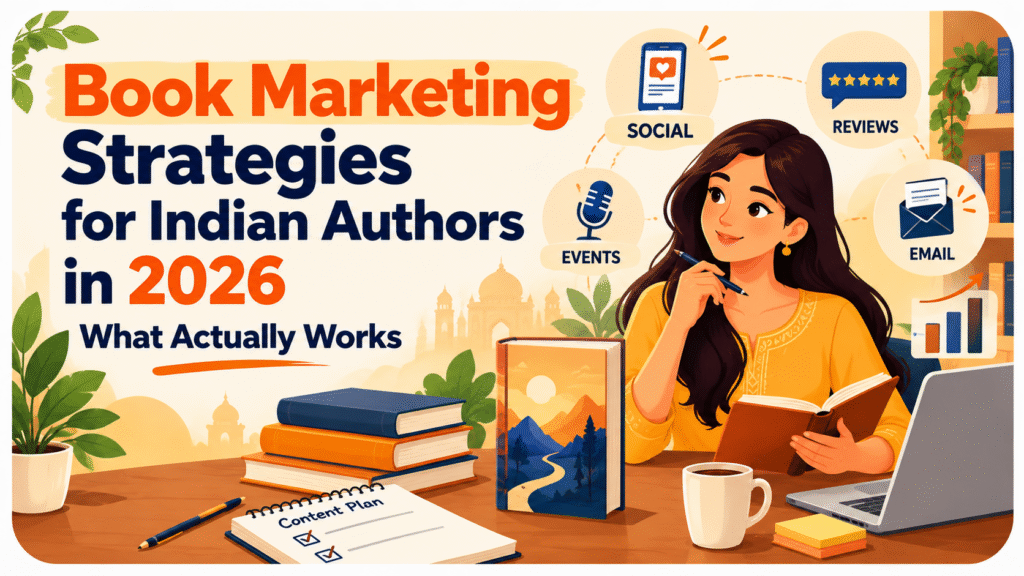
Book marketing India has changed considerably in recent years. Publishing a good book is still essential, but authors also need a practical way to help the right readers discover it.
However, effective marketing does not mean posting the book cover every day or spending heavily on advertisements. Instead, successful promotion usually combines a strong book page, clear author identity, useful content, reader reviews and consistent visibility.
Therefore, this guide focuses on book marketing strategies Indian authors can realistically use in 2026. More importantly, it explains what each strategy is meant to achieve and where authors often waste time or money.
What Does Book Marketing Actually Mean?
Book marketing is the process of helping suitable readers discover, understand and remember a book.
Promotion is only one part of that process. For example, marketing also includes the book cover, description, pricing, reviews, author profile, social media content and where the book is available.
A practical marketing plan may include:
- A clear target reader
- Professional book presentation
- Strong Amazon or retailer listing
- Author social media presence
- Reader reviews
- Email communication
- Book communities
- Events and interviews
- Paid advertising when appropriate
In other words, good marketing creates several small paths through which a potential reader can reach the book.
Book Marketing India: Start With the Right Reader
Before choosing Instagram, Amazon Ads or any other marketing channel, first identify the type of person most likely to read the book.
For example, marketing a Hindi poetry collection should look different from promoting a business guide or a children’s activity book.
Therefore, avoid defining the audience as simply “everyone who reads books.” A smaller and clearer audience is easier to reach.
Questions to Ask About Your Reader
- What age group is the book written for?
- Which language does the reader prefer?
- What other books might they already read?
- Where do they discover new books?
- Which problem, interest or emotion does the book address?
1. Get the Book Presentation Right First
Marketing cannot fully compensate for weak presentation. Therefore, the cover, title, description and interior quality should be ready before promotion begins.
Readers often make quick decisions. A professional cover can create interest, while a clear description helps the reader understand what the book offers.
Before promoting the book, check:
- Cover is clear at thumbnail size
- Title and subtitle are easy to understand
- Book description is readable
- Author name is consistent everywhere
- Price suits the target market
- Sample pages are professionally formatted
If the product page does not create confidence, bringing more visitors to it may not lead to more sales.
2. Improve Your Amazon Book Page
For books sold on Amazon, the product page is an important part of the marketing process.
A strong listing should make it easy for a reader to understand the book within a few moments. Therefore, pay attention to the description, categories, keywords, author information and available formats.
Amazon also provides authors with tools such as Author Central and advertising options. Its official KDP guidance recommends using author pages, websites, email and other outreach to promote books.
You can review Amazon’s official
Book promotion guidance
before planning Amazon-specific marketing.
3. Create an Amazon Author Page
An Author Page brings an author’s books and profile information together in one place.
In addition, Amazon Author Central allows authors to manage their biography, claim books and view information connected with their author profile. Author Pages are also available on Amazon.in for eligible books.
Therefore, authors with multiple books should not treat each title as a completely separate product. Instead, use the author identity to connect them.
4. Use Social Media to Create Interest, Not Just Ads
A common mistake is posting the same book cover with “Buy Now” again and again.
Instead, use social media to show readers why the book may interest them. For example, share ideas, questions, short excerpts, research, characters or behind-the-scenes material.
| Book Type | Content Ideas | Channels to Consider |
|---|---|---|
| Fiction | Characters, quotes, scenes, themes | Instagram, reader groups |
| Poetry | Poems, readings, visual excerpts | Instagram, YouTube |
| Business | Advice, lessons, short case studies | LinkedIn, newsletter |
| Self-Help | Practical tips, questions, exercises | Instagram, YouTube |
Of course, authors do not need to use every platform. One active channel is usually more useful than several inactive accounts.
5. Build Reader Reviews Gradually
Reviews can help new readers understand how others experienced a book.
Therefore, authors should make it easy for genuine readers to leave honest feedback after reading.
However, avoid buying fake reviews or trying to control what a reader writes. Short-term manipulation can damage trust and may also violate marketplace rules.
Who Can Receive Early Copies?
- Relevant reviewers
- Book bloggers
- Bookstagram creators
- Genre readers
- Book club members
- Media or podcast hosts
6. Send Advance Reader Copies Before Launch
Advance reader copies, often called ARCs, are copies shared with selected readers before or around publication.
The aim is not to guarantee positive reviews. Instead, ARCs give interested readers enough time to read the book and share an honest response.
For that reason, outreach should begin before launch rather than after the book has already been available for several weeks.
7. Build an Email List
Social media is useful for discovery. However, an email list gives authors a more direct way to speak with interested readers.
A newsletter does not need to be complicated. For example, authors can share writing updates, useful essays, events and occasional book news.
As a result, the audience can remain connected between book launches rather than disappearing after one campaign.
8. Work With Bookstagram and Reading Communities
Book communities can be useful because the audience is already interested in reading.
However, relevance matters more than follower count. A smaller reviewer who regularly discusses your genre may be more useful than a large lifestyle account with little interest in books.
Therefore, research each reviewer before sending a message. Personal outreach usually feels more professional than copying the same promotional text to hundreds of accounts.
9. Use Events to Create Real Reader Connections
Online promotion should not be the only strategy. In India, book launches, college events, literary festivals, readings and workshops can also create useful visibility.
Moreover, one event can create material for several online posts. Photographs, reader questions, short videos and quotes can all become future content.
Therefore, think of an event as both a reader interaction and a content opportunity.
10. Use Podcasts and Interviews
Podcasts and interviews can introduce an author to an audience they do not already have.
Instead of asking a host to “promote my book,” suggest a discussion topic connected with the book.
For example:
- An interesting part of your research
- A social issue explored in the book
- Your writing journey
- A lesson from your non-fiction subject
- A discussion around the book’s central theme
This approach gives the host a reason to invite you beyond simply advertising a product.
11. Use Amazon Ads Only After the Book Page Is Ready
Paid advertising can bring more people to a book page. However, advertising does not automatically make the product page convincing.
Therefore, check the cover, description, pricing and reviews before spending heavily.
Amazon currently makes advertising available for eligible KDP books in India, and authors can control their campaign budget.
You can review the official
Amazon advertising guidance for KDP books
before setting up a campaign.
12. Do Not Ignore Book Pricing
Marketing and pricing are closely connected. A campaign may bring people to the book page, but readers still decide whether the price feels reasonable.
Therefore, compare similar books before setting the MRP. At the same time, make sure the price still covers the commercial needs of the book.
For a detailed explanation, read our
Book pricing India 2026 guide
What Actually Works in Book Marketing?
| Strategy | Best Use | Main Goal |
|---|---|---|
| Strong Book Page | Every book | Turn interest into purchase consideration |
| Social Content | Long-term awareness | Reach and reader connection |
| ARCs and Reviews | Launch period | Reader trust |
| Email Newsletter | Repeat readership | Direct communication |
| Events | Local visibility | Personal connection |
| Paid Ads | Ready-to-convert book pages | Increase targeted traffic |
A 90-Day Book Marketing Plan
- Define the target reader
- Finalise the cover and description
- Prepare the Amazon or retailer listing
- Create author profiles
- Make a reviewer and book-community list
- Begin sharing useful social content
- Send selected advance copies
- Approach podcasts or reviewers
- Prepare launch-day posts
- Start collecting interested readers
- Announce availability clearly
- Share genuine reader reactions
- Continue useful content after launch
- Test advertising only when appropriate
- Review which channels produce real interest
What Usually Does Not Work?
Some activities can create numbers without creating readers.
- Buying followers
- Buying fake reviews
- Posting only book-cover advertisements
- Sending mass promotional messages
- Targeting everyone
- Running ads before improving the book page
- Using irrelevant hashtags only for reach
- Stopping all marketing immediately after launch
Instead, focus on finding readers who may genuinely care about the subject, genre or story.
How Much Should an Author Spend on Marketing?
There is no fixed marketing budget that suits every book.
A first-time author can begin with low-cost activities such as social content, reviewer outreach, newsletters and events. After that, paid advertising can be tested gradually.
Therefore, avoid spending the entire budget during the first few days of launch.
Instead, reserve part of the budget for continued promotion after the initial excitement has passed.
Measure the Results That Matter
Likes and impressions can be useful signals, but they should not be the only numbers you watch.
Useful marketing signals include:
- Book page visits
- Sales
- Newsletter signups
- Reader replies
- Reviews
- Event attendance
- Ad clicks and conversions
- Repeat purchases of later books
Amazon KDP also provides reporting tools for authors to review sales activity.
Book Marketing India Checklist
- Target reader defined
- Professional cover ready
- Book description improved
- Book price checked
- Amazon or retailer page ready
- Author profile completed
- Social content plan prepared
- ARC list prepared
- Reviewer outreach started
- Launch content prepared
- Post-launch promotion planned
- Results reviewed regularly
More Guides for Indian Authors
Authors planning to sell through Amazon can read our
Amazon KDP India 2026 guide
for publishing, ISBN and royalty basics.
You can also review our
Book pricing India guide
before finalising your MRP.
If your manuscript is still being prepared, our
Book editing guide for Indian authors
covers the main editing stages before publication.
Frequently Asked Questions About Book Marketing in India
When Should I Start Marketing My Book?
Start before publication when possible. This gives you time to prepare reader outreach, author profiles and launch content without rushing.
Which Social Media Platform Is Best for Authors?
There is no single best platform. Fiction and poetry authors may find Instagram useful, while business authors may find LinkedIn more relevant. The right choice depends on the reader.
Do Authors Need Paid Ads?
Not always. Authors can begin with organic content, reviewers, events and email. Paid ads can then be tested when the book page and audience are ready.
Do Book Reviews Help Marketing?
Genuine reader reviews can help new readers understand the book. However, reviews should be honest rather than purchased or manipulated.
How Long Should I Market a Book?
Marketing does not need to end after launch week. Instead, useful content, events and reader outreach can continue as long as the book remains relevant.
What Is the Most Important Book Marketing Strategy?
There is no single strategy that works for every book. However, a clear target reader, professional book page and consistent reader communication create a strong foundation.
How Tarang Prakashan Looks at Book Marketing
At Tarang Prakashan, book marketing is viewed as a process rather than a single launch-day activity.
Different books need different audiences and channels. Therefore, the same marketing plan should not be copied across poetry, fiction, children’s books and non-fiction.
The aim should be to present the book professionally, identify suitable readers and build visibility through relevant channels over time.
Book Marketing India: Final Thoughts
Book marketing India works best when authors stop looking for one quick trick and instead build several useful ways for readers to discover the book.
First, improve the book presentation and identify the target audience. Next, build visibility through social content, reviews, Amazon, email, events and reader communities.
After that, test paid advertising only when the book page is ready and the results can be measured.
Ultimately, good book marketing is not about showing the book to the largest possible audience. It is about showing it repeatedly and professionally to the readers most likely to care about it.