




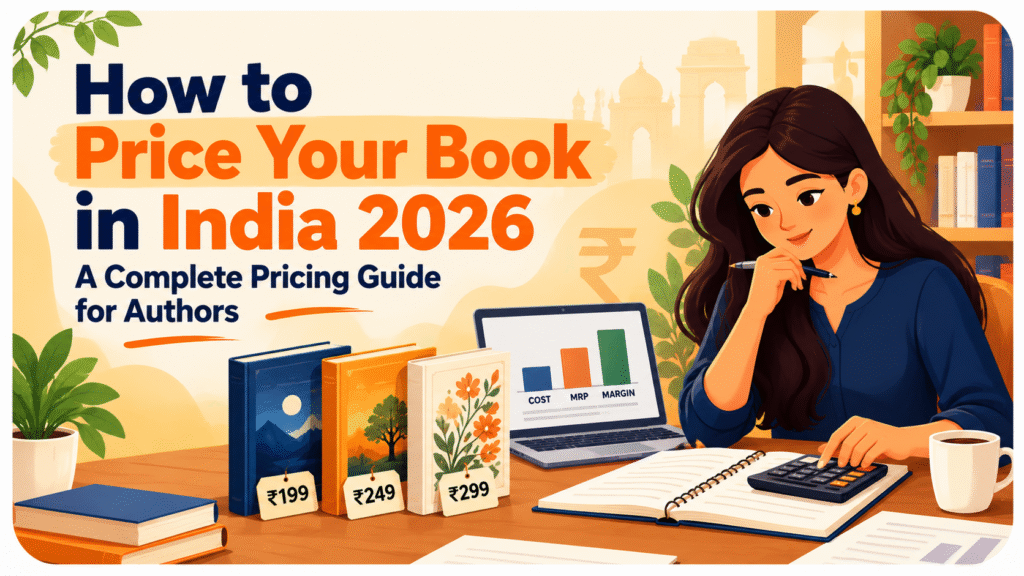
Book pricing India is one of the most important decisions authors make before publishing. Set the price too high and readers may hesitate to buy. Set it too low and there may not be enough margin to cover printing, selling costs and author earnings.
Therefore, the right book price should not be chosen randomly. Authors need to consider production cost, page count, format, reader expectations, sales channels and the amount left after each sale.
This 2026 guide explains how to price a book in India in simple terms. It also shows how paperback MRP, discounts, royalties and online selling costs can affect the final decision.
Why Book Pricing Matters
A book’s price affects much more than profit. It can also influence how readers compare the book with similar titles.
For example, a very expensive paperback from a first-time author may face resistance. On the other hand, an unusually low price may leave little room for discounts, marketplace charges or royalties.
A good book price should balance:
- Printing cost
- Book size and page count
- Paperback or hardcover format
- Online selling costs
- Retailer or distributor discount
- Author royalty
- Reader expectations
- Prices of similar books
In short, the aim is not to choose the highest possible MRP. Instead, the goal is to find a price that works for both the reader and the publishing model.
Book Pricing India: Start With the Cost of the Book
Before deciding the MRP, first understand how much one copy costs to produce.
Printing cost can change based on page count, book size, paper, binding, colour pages and quantity. Therefore, two books with the same selling price may have very different margins.
Production cost may include:
- Interior printing
- Cover printing
- Lamination
- Binding
- Applicable taxes
- Packaging, where applicable
Once the per-copy production cost is known, pricing becomes much easier to plan.
1. Page Count Has a Direct Effect on Price
In most printing models, a longer book costs more to produce. Therefore, page count is one of the first factors to consider.
A 100-page paperback and a 400-page paperback cannot usually be priced in the same way. Even when both have the same trim size, the longer book uses more paper and requires more printing.
However, avoid increasing the MRP only because the book is long. Reader expectations and competing titles still matter.
2. Book Size Also Changes the Cost
Trim size affects how much paper is used and how many pages the manuscript becomes after typesetting.
For example, the same manuscript may have fewer pages in a larger format and more pages in a smaller format. As a result, production cost can change.
Therefore, authors should finalise the book size and typesetting before calculating the final MRP.
3. Paperback and Hardcover Need Different Pricing
A hardcover edition normally costs more to manufacture than a paperback. Consequently, the hardcover MRP should usually be higher.
| Format | Typical Cost Level | Pricing Approach |
|---|---|---|
| Paperback | Lower | Keep accessible for wider readership |
| Hardcover | Higher | Allow room for higher production cost |
At the same time, the price gap should still feel reasonable to the reader.
4. Understand MRP, Selling Price and Your Actual Receipt
One of the biggest pricing mistakes is assuming that the publisher or author receives the full MRP.
In reality, a book may be sold below MRP because of retailer discounts. In addition, marketplaces or distribution channels may deduct their own charges before the remaining amount is calculated.
Therefore, always calculate from the amount you actually expect to receive rather than assuming every sale happens at full MRP.
5. Leave Room for Book Discounts
Discounts are common in online and offline book selling. For that reason, the MRP should not be so low that even a normal discount removes the entire margin.
For example, imagine a book with an MRP of ₹300. If it sells at a 20% discount, the customer pays ₹240 before any other applicable deductions.
Therefore, pricing should be tested at several possible discount levels before the book goes live.
6. Consider Marketplace and Distribution Costs
Selling directly and selling through an online marketplace are not financially identical.
Online channels may apply fees, discounts or other deductions depending on the selling model. Furthermore, the exact structure may change over time.
For that reason, authors should check the current terms of the platform they plan to use before fixing a final price.
Authors using Amazon KDP can review the
Official KDP pricing and royalty guidance
before choosing a list price.
7. Decide How Much Margin the Book Needs
A selling price should normally leave enough room to cover the cost of producing and selling the book.
After that, the remaining amount may contribute to publisher margin, author earnings or other costs depending on the publishing arrangement.
As a result, pricing only a few rupees above printing cost can create problems when discounts or channel deductions are applied.
8. Compare Similar Books Before Setting the MRP
Production cost tells you what the book needs financially. However, the market tells you what readers are used to paying.
Search for books that are similar in genre, format, page count and audience. Then compare their paperback or hardcover prices.
This does not mean copying another book’s price. Instead, use the comparison to check whether your proposed MRP feels realistic.
9. Consider the Book’s Genre and Reader
Readers do not expect every type of book to cost the same amount.
For instance, a short poetry collection, children’s book, academic title and large reference book serve different audiences. Therefore, each should be priced with its own market in mind.
| Book Type | Pricing Consideration |
|---|---|
| Novel | Compare similar fiction in the same format and length |
| Poetry | Page count may be lower, so reader value matters strongly |
| Children’s Book | Colour printing and illustrations can raise production cost |
| Academic / Reference | Specialist content may support a different price range |
10. Do Not Price a Book Only by Page Count
Page count matters, but it should not become the only pricing rule.
A specialised 120-page professional guide may offer more value to its target reader than a much longer general book. Likewise, a premium illustrated book can cost more even with fewer pages.
Therefore, consider both production cost and perceived reader value.
A Simple Book Pricing Example
Suppose a paperback costs ₹100 per copy to produce. Pricing it at ₹120 may look affordable, but that leaves very little room for retailer discounts or selling costs.
Now imagine the same book has an MRP of ₹249. If the selling channel offers a discount, there is more room to absorb that reduction before reaching the production cost.
This example does not include any marketplace, distribution, tax or other deductions. Therefore, it should only be used to understand the basic pricing idea.
How to Calculate a Practical Book MRP
Find the final production cost per copy.
Estimate the normal discount at which the book may sell.
Check likely retailer, marketplace or distribution deductions.
Decide how much margin needs to remain after these costs.
Compare your proposed MRP with similar books.
Adjust the final MRP until both the commercial calculation and reader value make sense.
Common Book Pricing Mistakes
Poor pricing can make a good book harder to sell or financially difficult to maintain.
- Setting MRP before knowing the printing cost
- Ignoring retailer discounts
- Assuming the full MRP is received on every sale
- Copying another book’s price without comparing costs
- Pricing too low simply to attract buyers
- Pricing too high only to create a larger margin
- Using the same pricing logic for paperback and hardcover
- Ignoring online platform costs
- Failing to compare similar books in the market
Instead, pricing should be decided after the book’s production details are final.
Should You Use ₹199, ₹249 or ₹299?
Prices ending in 9 are common in retail because they can look more familiar to customers. However, there is no rule that every book should use this style.
A ₹249 price may work well for one paperback but be completely unsuitable for another. Therefore, calculate the economics first and choose the final number afterward.
Reader perception matters, but sustainable pricing matters too.
How Does Book Pricing Affect Author Royalty?
Royalty depends on the publishing arrangement rather than MRP alone.
For example, some publishing models calculate royalty as a percentage of MRP. Others calculate earnings from net receipts or the amount left after specific selling costs.
Therefore, authors should understand the royalty clause in their publishing agreement before comparing book prices.
Book Pricing India Checklist
- Final page count confirmed
- Trim size confirmed
- Paperback or hardcover format confirmed
- Per-copy printing cost calculated
- Likely customer discount considered
- Selling-channel costs checked
- Royalty model understood
- Similar books compared
- Reader expectations considered
- Final margin tested at different selling prices
More Publishing Guides for Authors
If you plan to sell through Amazon, read our
Amazon KDP India 2026 guide
to understand publishing formats, ISBN options and royalties.
Before calculating your final book price, you can also review our
Book editing guide for Indian authors
to understand another important part of book preparation.
Frequently Asked Questions About Book Pricing in India
How Should I Decide the MRP of My Book?
Start with the production cost. Then consider discounts, selling-channel deductions, required margin and prices of similar books before choosing the final MRP.
Should I Keep My Book Price Low to Get More Sales?
Not necessarily. A lower price may attract some readers, but it can also leave too little margin after printing and selling costs. Therefore, price should be competitive rather than simply cheap.
Does a Longer Book Need a Higher MRP?
Often, a longer book costs more to print. However, page count is only one factor. Genre, format, reader value and competing titles should also be considered.
Should Paperback and Hardcover Have the Same Price?
Usually not. Hardcover production generally costs more, so its MRP is normally higher than the paperback edition.
Does the Author Receive the Full MRP?
Usually, no. The amount received depends on the sales channel, discount, publishing arrangement and other applicable deductions.
Can I Change My Book Price Later?
In many publishing and marketplace systems, prices can be updated later. However, the process depends on where and how the book is published.
How Tarang Prakashan Looks at Book Pricing
At Tarang Prakashan, book pricing is considered along with the format, production cost, page count and intended sales channel.
A price should make sense commercially while still remaining reasonable for the book’s target reader. Therefore, the same pricing formula cannot be applied to every title.
The final decision should be based on the actual book rather than an arbitrary price point.
Book Pricing India: Final Thoughts
Book pricing India requires a balance between affordability and financial sustainability.
First, calculate the actual production cost. Next, consider discounts, selling channels and the amount that needs to remain after a sale.
After that, compare similar books and ask whether the proposed price makes sense to the target reader.
Ultimately, the right book price is not simply the lowest or highest number you can choose. It is the price that supports the book’s market position while keeping the publishing model practical.