



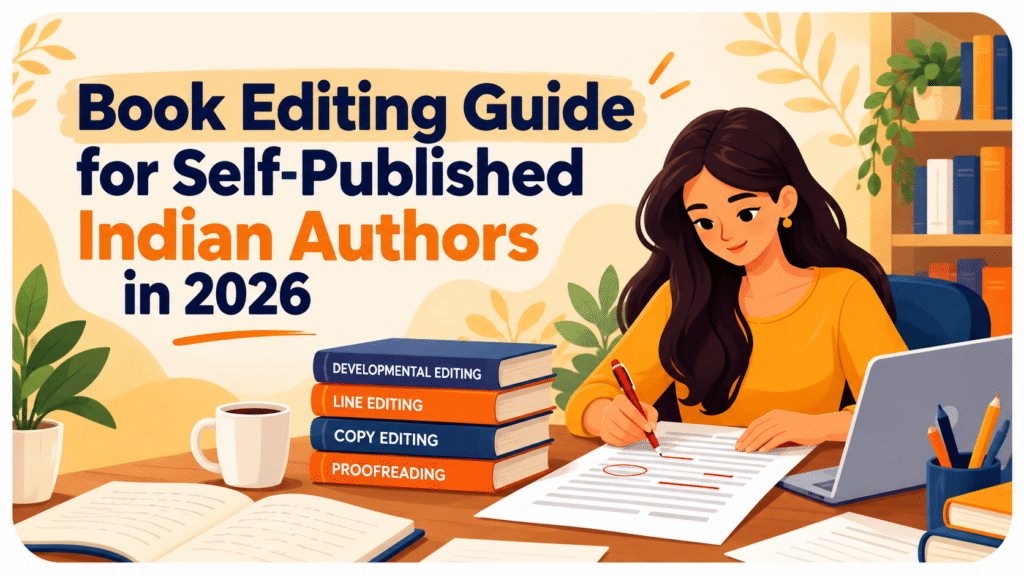
Book editing India is an important topic for self-published authors who want their manuscript to look professional before publication. Good editing improves clarity, removes mistakes and gives readers a smoother reading experience.
Writing the manuscript is only the first stage. After that, the book normally needs careful review for structure, language, grammar, consistency and final errors.
Therefore, authors should understand the different types of editing before choosing a service. This guide explains the complete process in simple language for Indian writers planning to self-publish in 2026.
Why Book Editing Matters for Indian Authors
Editing improves much more than spelling and grammar. In fact, a good editor also looks at how clearly the book communicates with its reader.
A manuscript may contain strong ideas but still feel slow, confusing or repetitive. As a result, readers may lose interest even when the subject is good.
Book editing can improve:
- Story or chapter structure
- Clarity of ideas
- Sentence flow
- Grammar and punctuation
- Names and terms
- Repeated information
- Spelling and typing errors
Most importantly, editing helps authors express their ideas clearly while keeping their own writing style.
Editing and Proofreading Are Not the Same
Many first-time authors confuse editing with proofreading. However, the two stages solve different problems.
Editing improves the content, structure and language of a manuscript. Proofreading, on the other hand, checks the final book for smaller mistakes.
| Stage | Purpose | Main Checks |
|---|---|---|
| Editing | Improve the manuscript | Structure, clarity, language and flow |
| Proofreading | Final quality check | Typos, punctuation, spacing and small errors |
Therefore, proofreading should not replace editing when the manuscript still needs larger changes.
Types of Book Editing in India
When looking for book editing India services, authors may find several different editing terms. Each type serves a different purpose.
1. Developmental Editing
Developmental editing looks at the book as a whole. Usually, it is the deepest stage of editing.
For fiction, an editor may examine plot, characters, pacing and chapter order. Meanwhile, non-fiction editing may focus on the order of ideas, missing information and repeated points.
A Developmental Editor May Check:
- Does the book have a clear purpose?
- Are chapters arranged properly?
- Does the story move at a good pace?
- Are the characters convincing?
- Are important ideas missing?
- Are some sections unnecessarily long?
Because this stage may require major changes, it should usually happen before detailed language editing.
2. Line Editing
Line editing focuses on the quality and flow of individual sentences.
For example, an editor may simplify an awkward sentence, remove unnecessary words or improve a weak transition. In addition, repeated phrases may be reduced.
However, good line editing should not erase the author’s natural voice. Instead, it should make that voice clearer.
3. Copy Editing
Copy editing focuses mainly on correctness and consistency.
A copy editor usually checks:
- Grammar
- Punctuation
- Spelling
- Sentence structure
- Capitalisation
- Repeated words
- Names and terms
- Style consistency
For instance, if a character’s name changes spelling between chapters, a copy editor should identify the error.
4. Proofreading
Proofreading is normally the final language check before the book is published.
By this point, major editing should already be complete. Therefore, the proofreader mainly looks for smaller mistakes.
A final proofread can find:
- Typing errors
- Missing punctuation
- Extra spaces
- Incorrect page references
- Wrong quotation marks
- Small formatting problems
Ideally, the final proofread should happen after typesetting. This way, errors created during page layout can also be found.
Which Editing Service Does Your Manuscript Need?
Not every book needs the same type of editing. Therefore, start by looking at the current condition of your manuscript.
| Manuscript Condition | Editing to Consider |
|---|---|
| Story or structure needs work | Developmental Editing |
| Writing feels awkward or repetitive | Line Editing |
| Content is strong but language has errors | Copy Editing |
| Book is already edited and typeset | Proofreading |
How to Prepare Your Manuscript for Book Editing
Before sending your manuscript to an editor, complete at least one careful self-review.
First, read the manuscript from beginning to end. Next, remove obvious repetition, unfinished sections and notes that are not meant for readers.
Manuscript Preparation Checklist
- Complete every chapter
- Arrange chapters correctly
- Remove duplicate text
- Check character and place names
- Use clear chapter headings
- Save a backup copy
- Provide an editable manuscript file
As a result, your editor can spend more time improving the manuscript instead of correcting basic preparation issues.
Can You Edit Your Own Book?
Self-editing is useful, and every author should do it. However, writers often find it difficult to notice every problem in their own manuscript.
After reading the same pages several times, the brain starts to overlook small mistakes. For that reason, self-editing works best as the first stage rather than the final stage.
How to Choose a Book Editor in India
Choosing a suitable editor is important because editing needs vary by genre.
For example, editing a novel is different from editing a business book. Likewise, poetry, academic work and self-help books may need different approaches.
What Should You Check Before Hiring an Editor?
- Experience with your type of book
- Type of editing included
- Sample editing quality
- Expected delivery time
- Revision policy
- How corrections are shown
- Total cost
Whenever possible, ask for a short sample edit. This can help you understand the editor’s working style before committing to the full manuscript.
Book Editing India: What Affects the Cost?
There is no single fixed price for book editing India services. Instead, the cost depends on the amount and type of work required.
For example, developmental editing usually takes more time than proofreading. Therefore, two manuscripts with the same number of pages may still have very different editing costs.
Common factors include:
- Word count
- Editing level
- Current manuscript quality
- Language
- Book genre
- Deadline
- Number of revisions
Therefore, compare what each editing service includes instead of choosing only by the lowest price.
Common Book Editing Mistakes
Many editing problems are avoidable. Nevertheless, first-time authors often make a few common mistakes.
- Publishing the first draft
- Depending only on spell-check software
- Skipping proofreading
- Making major changes during the final editing stage
- Accepting every suggested edit without reviewing it
- Ignoring inconsistent names and terms
- Failing to check the book after typesetting
Above all, remember that editing should make the book better without taking away the author’s individual voice.
Can AI Help With Book Editing?
AI tools can help identify simple grammar errors, repeated words and unclear sentences. Therefore, they can be useful during early self-editing.
However, software may not fully understand humour, emotion, cultural context, character development or the author’s intended meaning.
For that reason, AI is better used as a support tool rather than the only editor of a book.
Recommended Editing Order Before Publishing
Review and clean the manuscript yourself.
Fix major story, chapter or content problems.
Improve language, flow, grammar and consistency.
Prepare the final interior layout.
Review the formatted pages before publication.
Book Editing Checklist for Self-Published Authors
- The manuscript is complete
- Chapters are arranged correctly
- Major content issues are resolved
- Grammar has been reviewed
- Names and terms are consistent
- Repeated information has been removed
- Formatting is consistent
- Typeset pages have been proofread
- Final corrections have been checked
Helpful Editing Resources
Authors who want to understand grammar and writing rules can also use trusted educational resources during self-editing.
For example, the
Purdue Online Writing Lab
offers useful guidance on grammar and writing.
For detailed style questions, authors can also explore
The Chicago Manual of Style
More Publishing Resources from Tarang Prakashan
Editing is only one part of preparing a book. Authors can also explore the
Tarang Prakashan publishing guides
for more information about writing, publishing and book promotion.
You can also learn more about the publishing support available through our
Publishing services
Frequently Asked Questions About Book Editing
Does Every Self-Published Book Need Editing?
Most manuscripts benefit from editing. Although the level may differ from book to book, an independent review can find problems the author may have missed.
What Is the Difference Between Editing and Proofreading?
Editing improves content, language and structure. In contrast, proofreading is the final check for small errors before publication.
Should Proofreading Happen After Typesetting?
Yes, a final proofread after typesetting is useful. This allows both text errors and layout-related problems to be checked together.
Can Authors Edit Their Own Books?
Authors should always self-edit. However, another careful reader or professional editor may notice problems that the author no longer sees.
How Long Does Book Editing Take?
The time depends on the book’s length, editing level and manuscript condition. Naturally, a book needing major structural changes will take longer than a final proofread.
Book Editing at Tarang Prakashan
At Tarang Prakashan, editing is treated as an important stage of preparing a manuscript for publication.
Different books need different levels of support. Therefore, the editing process should depend on the manuscript, language, genre and overall writing quality.
At the same time, an author’s original voice should remain intact. The aim is to improve clarity, flow and readability without unnecessarily changing the writer’s meaning.
Final Thoughts
For self-published writers, book editing India should be treated as a planned part of the publishing process rather than a last-minute task.
First, review the manuscript yourself. Next, identify the editing level your book needs. After that, complete the professional editing, typesetting and final proofread in the correct order.
Ultimately, good editing does not change what an author wants to say. Instead, it helps the author say it more clearly and gives readers a better finished book.